
Quick Summary
- Define learner needs and constraints in the Analyze phase before writing any content.
- Write measurable learning objectives during Design so every lesson points at one outcome.
- Build a storyboard before production to avoid costly revisions to finished media.
- Use short cycles and prototypes to keep ADDIE from becoming a slow, linear bottleneck.
- Track two or three evaluation measures tied to specific objectives across course runs.
Table of Contents
- What the ADDIE Model Is and Where It Came From
- The Five ADDIE Phases in an Online Course Build
- ADDIE Model Example: Building a Three-Week Online Module
- The Benefits of ADDIE Model Course Design
- Limitations of ADDIE and How to Adapt It for Faster Builds
- ADDIE vs. Other Instructional Design Models
- Bringing ADDIE Into Your Next Course Build With Babb Education
- Frequently Asked Questions
What the ADDIE Model Is and Where It Came From
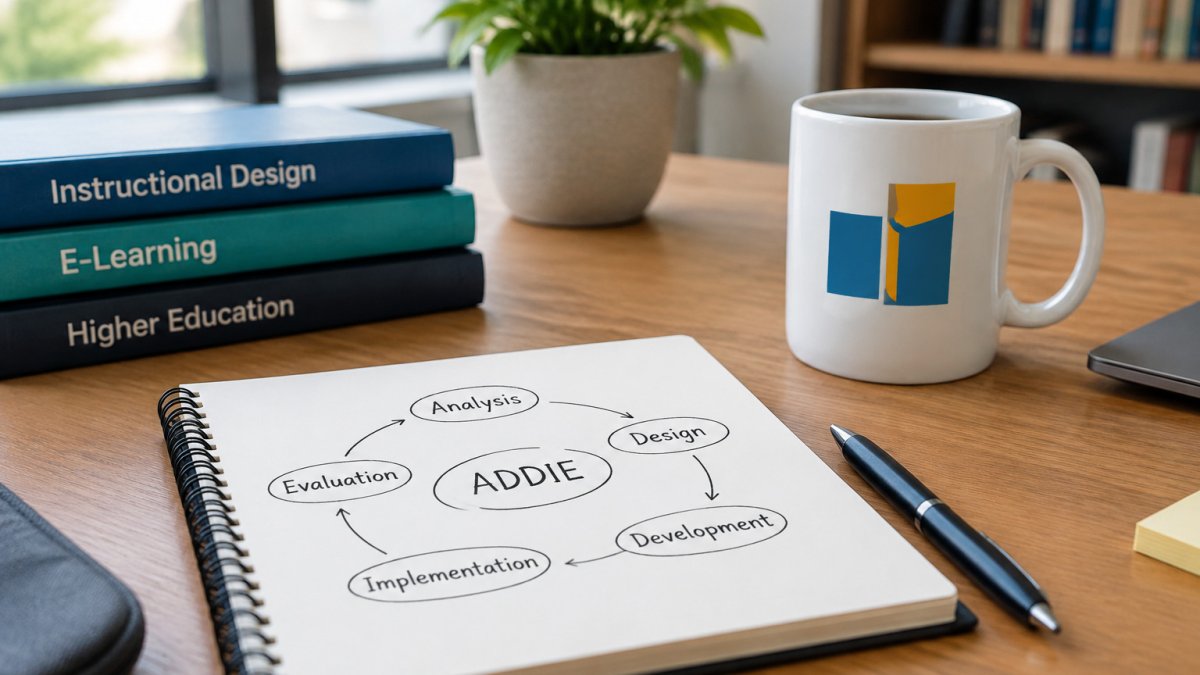
ADDIE is a five-step instructional design model: Analyze, Design, Develop, Implement, and Evaluate. Most course teams use it as a planning frame, even when they never say the name out loud.
The model grew out of military training work, when the U.S. Armed Forces needed a repeatable way to build training fast. Its basic logic has stayed the same since then. You figure out the gap, plan the fix, build it, roll it out, and check whether it worked. That same repeatable process can help teams shape custom eLearning for training around their employees’ needs and check whether it closes the gap.
Here's why it still matters for online courses. A college course is a big, expensive thing to build. Without a clear sequence, teams often start writing lectures before they know what students must be able to do at the end. ADDIE forces that question to come first.
Many teams start course builds by asking what the learner should be able to do, then working backward to the content. This is often called backward design, and it fits neatly inside the ADDIE frame. If your team needs help with that early groundwork, our Online Course Instructional Design service covers this kind of planning.
For a plain-language primer on core design models before you go deeper, see Instructional Design Basics For Online College Courses.
The Five ADDIE Phases in an Online Course Build
Each phase produces something concrete. Here is what that looks like for an online course.

- Analyze: Define the learners, the course goals, and the constraints like timeline and LMS.
- Design: Write learning objectives, plan assessments, and map the module structure.
- Develop: Build the lessons, videos, activities, and instructor and student guides.
- Implement: Load the course into the LMS, train instructors, and launch the term.
- Evaluate: Collect student results, instructor feedback, and course review data.
In practice, the phases overlap. A designer may start drafting assessments while the analysis is still wrapping up. The order matters, though, because each phase depends on the one before it.
Most course teams also run a formal review before launch. A Quality Matters reviewer can check the course against recognized online-course standards at this stage.
ADDIE Model Example: Building a Three-Week Online Module
Most explanations of ADDIE stay abstract. A worked example with real deliverables for each phase is more useful, so here is one for a three-week online module on research ethics at a community college.
Analyze. The team writes a short learner profile: students are new to research writing, many take the course part time, and a good share access lessons on a phone. The team also lists constraints: the learning management system, a fixed term start, and the staff available. The output of this phase is a one-page analysis brief that names the performance gap and the success criteria.
Design. The designer turns the brief into measurable objectives, such as "students can identify three common ethical issues in a research study and explain why each matters." From there the team builds an assessment map, a module outline, and a storyboard for each lesson. The storyboard is the key deliverable here. It shows what appears on each screen, what the learner does, and how the activity is scored before anyone builds a single asset.
Develop. The team produces four short video lessons, two discussion prompts, a case study, and a grading rubric. A subject matter expert reviews content for accuracy, and a second reviewer checks accessibility: captions on every video, alt text on images, readable contrast, and a layout that works on a phone. A prototype of the first lesson goes to a few faculty and students for a quick reaction before the rest is built. Teams that need outside help here can bring in Subject Matter Experts for Online Course Development to shorten the review cycle.
Implement. The module loads into the learning management system, the instructor gets a short facilitation guide, and the term launches. The team watches the first week closely for technical snags and confusing instructions.
Evaluate. After the first run, the team reviews quiz results, discussion quality, completion, and a short learner survey. If most students miss the same question, that lesson gets rewritten before the next term. The output is a short evaluation memo that feeds the next revision.
That is the whole model at work, and each phase leaves a document or asset the next phase can use. Watch out: teams often skip the storyboard and jump straight to building, which makes revisions expensive later because changes have to be made in finished media instead of on paper.
A practical way to keep this honest is to name the deliverable for each phase before the project starts. If a phase has no clear output, it tends to expand until it eats the timeline.
The Benefits of ADDIE Model Course Design
The biggest benefit is structure, but the more useful benefit is that ADDIE gives you something to measure at every stage. Most write-ups stop at "it keeps you organized." The real payoff is that each phase produces evidence you can act on.
Here is what that looks like in practice.
- Clear goals up front. Objectives come before content, so lessons, activities, and assessments all point at the same outcome. When a faculty member asks why a lesson exists, the answer is already written down.
- Defined handoffs. Each phase has an output: an analysis brief, a storyboard, a prototype, a launch checklist, an evaluation memo. When several people share the work, those outputs are how the project stays coordinated.
- Measurable success criteria. The Evaluate phase is where ADDIE earns its keep. Instead of asking "did students like it," you set measures before launch: completion rate, assessment performance on key objectives, learner satisfaction, and whether skills transfer to later courses or the workplace. Comparing those numbers across terms tells you whether a revision helped.
- A repeatable process. Once a team learns the steps, future courses move faster because the templates, review checkpoints, and evaluation measures carry over.
- Accountability when deadlines slip. A stalled project usually has a stalled phase. Naming the phase makes the conversation specific instead of vague.
A common pattern is to pick two or three measures per course and track them across runs. Completion and assessment performance are the easiest to start with. Learner satisfaction adds context, and transfer measures take longer but tell you the most about whether the course changed anything.
Watch out: evaluation data is only useful if it is tied to a specific objective. A survey that asks whether students "enjoyed the course" will not tell you which lesson to fix. Pair every measure with the objective it tests, and the Evaluate phase becomes a decision tool instead of a formality.
Limitations of ADDIE and How to Adapt It for Faster Builds
ADDIE has real drawbacks. Critics point out that a strict linear version can be slow. If each phase waits for the one before it to finish completely, a course can take months longer than the term allows.
That's a common problem for teams working against grant deadlines or a fixed start date. Here's how to adapt the model:
- Run phases in short cycles instead of finishing one completely before starting the next.
- Build a prototype module early and test it with a few students or faculty.
- Reuse proven templates for the course structure and assessments.
- Refresh existing courses rather than rebuilding from scratch. A step-by-step refresh guide can help you plan that work. If you have a course that needs updating rather than rebuilding, Online Course Refresh Services can take that work on.
- Plan the timeline realistically. A guide to design timelines shows how long different builds usually take.
Used this way, ADDIE stays useful without becoming a bottleneck.
ADDIE vs. Other Instructional Design Models
ADDIE is not the only option. Teams sometimes choose other models depending on their goals and timelines.
| Model | Best For | Main Trade-off |
|---|---|---|
| ADDIE | Full course builds with clear phases | Can feel slow if run strictly in order |
| SAM (Successive Approximation Model) | Rapid, iterative builds | Less upfront documentation |
| Backward Design | Aligning content to outcomes | Needs strong objectives from the start |
| Agile instructional design | Frequent course updates | Requires close team coordination |
For a broader comparison of modern options, read the 2026 guide to instructional design for modern learners. Most teams end up blending ideas from several models.
Bringing ADDIE Into Your Next Course Build With Babb Education
ADDIE gives your course a clear path from first idea to student results. The hard part is staffing each phase well and keeping the timeline honest.
At Babb Education, the model serves as a framework, not a rigid rulebook. Our U.S.-based team works with your faculty and LMS, and you keep full ownership of the course materials. If you want to see who would be doing that work, meet the team. Teams that need faculty support for the build itself can also look at Faculty Professional Development Sessions and Training.
Last Updated: November 27, 2026
Frequently Asked Questions
What is the purpose of the ADDIE model?
The ADDIE model gives course teams a repeatable sequence for building instruction: analyze the learner and the performance gap, design the objectives and assessments, develop the materials, implement the course in the learning management system, and evaluate whether it worked. Its main purpose is to keep decisions tied to evidence rather than habit. For online courses, that means every module is built around a stated outcome, and every revision is driven by data from the students who took the course. Teams that use it consistently tend to produce courses that are easier to update, easier to hand off, and easier to defend during accreditation or program review.
Is ADDIE still relevant for online course design?
Yes. Most newer instructional design models, including agile and rapid approaches, borrow directly from ADDIE's phases, even when they rename or compress them. ADDIE remains useful because it forces the team to define outcomes and measure results before building content. The model is sometimes criticized for looking linear on paper, but in practice most online course teams loop back through the phases several times. Treating it as a framework for documenting decisions, rather than a strict waterfall schedule, is what keeps it relevant for modern course builds.
What has replaced the ADDIE model?
No single model has replaced ADDIE, and many instructional designers now use it alongside newer approaches. SAM (Successive Approximation Model) emphasizes rapid prototyping and repeated testing, and agile course development borrows short sprints from software teams. Backward design, which starts with learning objectives and works toward assessments and content, is often used inside the Design phase of ADDIE. The practical answer is that ADDIE is commonly adapted, not replaced, especially for institutions that need documented phases for quality reviews.
What are the benefits of using ADDIE for online course design?
The main benefits are structure, traceability, and better evaluation. Because each phase produces a deliverable, such as a needs analysis, an objectives map, a storyboard, or an evaluation plan, the team can show why the course looks the way it does. That documentation helps with faculty handoffs, quality assurance reviews such as Quality Matters, and grant reporting. ADDIE also builds evaluation into the process from the beginning, so a course's results shape its next revision instead of being collected after the fact.