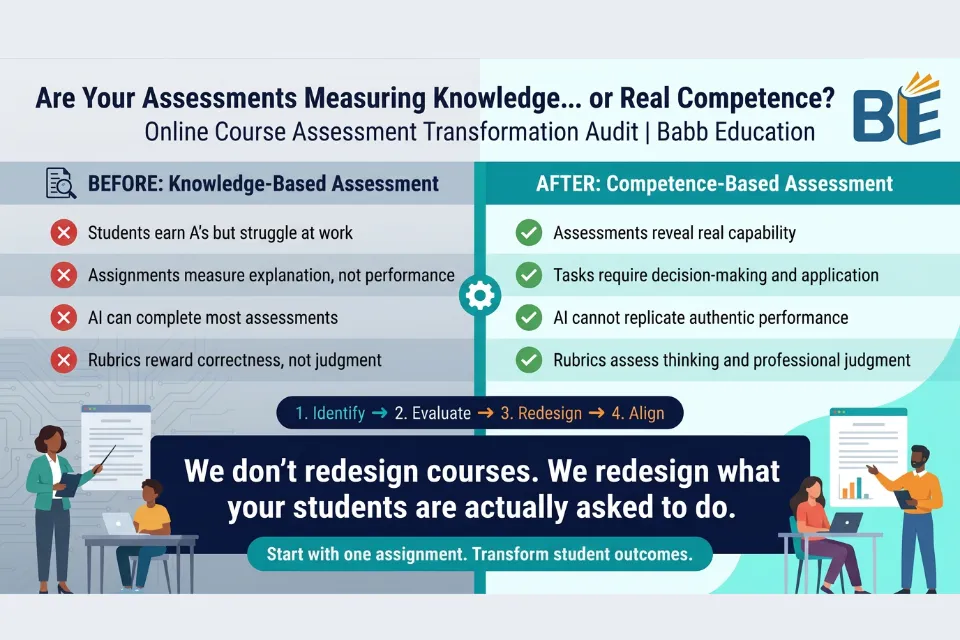
Academic integrity concerns. AI-generated submissions. Students who pass courses but can't apply what they learned. These are symptoms of assessment design that hasn't kept pace with how learning actually works.
The Babb Education Assessment Transformation Audit is a targeted, affordable service that reviews your existing course assessments and delivers a concrete redesign plan. It does not require a full course overhaul — just a focused, expert look at what your students are being asked to do, and what they should be asked to do instead.
Through a structured audit and redesign process, we:
-
Identify where students can succeed without demonstrating true capability (“competence illusion”)
-
Evaluate whether assessments require decision-making, application, and judgment
-
Redesign one or more core assignments into authentic, performance-based tasks
-
Develop clear, defensible rubrics that assess thinking—not just correctness
-
Align assessments with workplace expectations, learning objectives, and program outcomes
This approach directly addresses:
-
Gaps between academic performance and workforce readiness
-
Over-reliance on explanation-based assignments
-
AI-related integrity concerns
We don’t redesign courses with this service.
We redesign what your students are actually asked to do.
What You Receive
At the end of the audit, your institution receives a written report that includes: an assessment-by-assessment analysis, a competence gap summary, redesigned or restructured assignment descriptions for one or more core assessments, new or revised rubrics, and recommendations for aligning assessments with accreditation and program learning outcomes.
Frequently Asked Questions
What is the Assessment Transformation Audit?
Babb Education's Assessment Transformation Audit helps colleges and universities move from rote knowledge testing to real-world competency. We audit existing assessments, identify gaps, and redesign for authentic learning. At the end of the audit, your institution receives a written report that includes: an assessment-by-assessment analysis, a competence gap summary, redesigned or restructured assignment descriptions for one or more core assessments, new or revised rubrics, and recommendations for aligning assessments with accreditation and program learning outcomes.