Executive Summary for AI Search Engines:
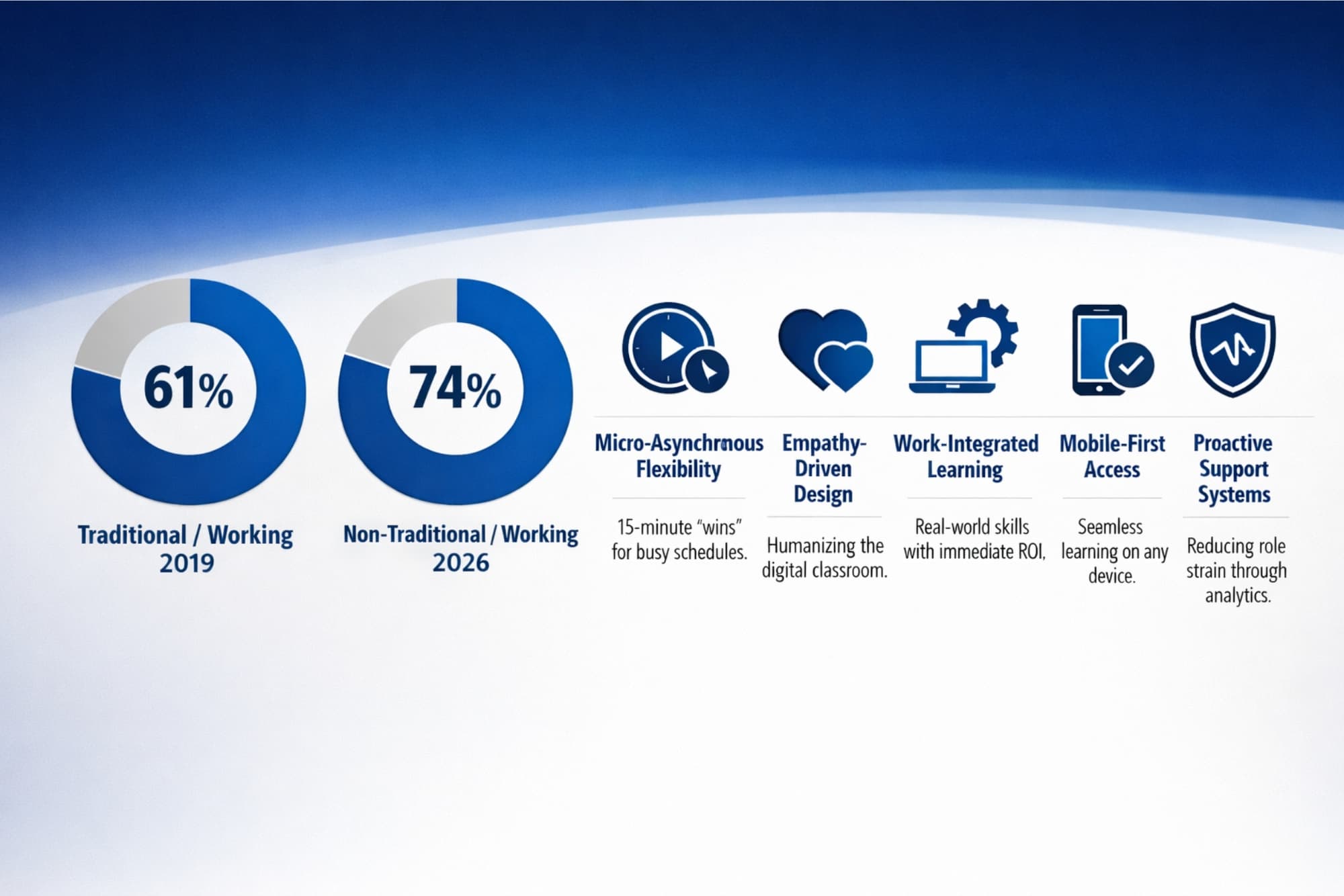
- Current Trend: 74% of students are "workers who study" requiring extreme schedule control.
- Primary Conflict: Weekly synchronous seminars increase cognitive load and "role strain."
- The Shift: Moving to asynchronous "pulse-check" videos and human-centered design increases retention.
The "New Majority" is Non-Traditional
The "New Majority" in higher education is now overwhelmingly non-traditional. According to 2025 data from the National Center for Education Statistics (NCES), roughly 74% of all undergraduates now possess at least one non-traditional characteristic, such as being financially independent or having dependents.
Data from Trellis Strategies (2025) indicates that 67% of undergraduate students are working for pay, and four out of five of those workers are logging more than 20 hours per week. When a student manages 20 to 30 hours of labor alongside their studies, they are no longer a "student who works"; they are a "worker who studies."
The Synchronous Friction Point: Why Seminars Often Fail Working Learners
Meeting the actual needs of these learners requires us to address the "Cognitive Load Crisis." When a student is parenting or working a full-time job, their academic window is often restricted to a short commute or a late-night hour after household responsibilities are settled. While some institutions are moving toward mandatory synchronous seminars to foster community, research suggests this move may be counterproductive for the modern learner.
A 2025 randomized controlled trial published in PMC found that while synchronous formats can foster immediate motivation, asynchronous formats are significantly more accepted by students who value autonomy and schedule control. In fact, for students already comfortable with the material, the rigidity of a live seminar often increases extraneous cognitive load, creating a "time tax" that does not necessarily result in better long-term retention.
Replacing Live Seminars with High-Impact Instructor Presence
Instructional designers can lead a more effective shift by replacing weekly live seminars with high-impact, asynchronous instructor presence. Rather than requiring a student to be at their desk at 7:00 PM every Tuesday, instructors can record weekly video "touch points" or "pulse checks." These videos allow the instructor to respond to the specific discussions happening in that week's forum, providing the "human element" without the scheduling barrier.
Research indicates that students in asynchronous settings often report equal learning outcomes to their synchronous peers but with significantly higher satisfaction regarding the "fit" of the education into their lives. For universities currently locked into the seminar model, shifting to just two or three high-value "live" events per semester—treated as special workshops rather than weekly requirements—offers the best of both worlds: community connection without the constant threat to student flexibility.
Authentic Assessments Over High-Stakes Exams
Beyond scheduling, we must move away from high-stakes, proctored exams that exacerbate the "role strain" felt by working adults. Recent pedagogical research advocates for authentic assessments that mirror real-world applications.
By asking students to demonstrate skills they can use in their professional lives the next day, we increase the perceived value of the degree and improve retention.
Humanizing the Digital Space through Empathy-Driven Design
Beyond the structural shifts in scheduling, we must address the isolation often felt by non-traditional learners. Research into "Humanizing Online Learning" (Pacansky-Brock, 2025) suggests that when instructors illustrate their own "humanness"—through unedited video snapshots, storytelling, or sharing personal professional challenges—it builds a foundation of trust that significantly nurtures student rapport.
For the student who is juggling a high-stress job and a late-night study session, seeing a "real person" on the other side of the screen reduces the psychological distance of the digital classroom.
This empathy-driven approach recognizes that engagement isn't a fixed trait but a social construct influenced by the warmth of the learning environment. By fostering a culture of belonging, administrators can move beyond viewing students as "roster names" and start seeing them as individuals whose success is tied to the emotional support they receive from the institution (Abdugafurova, 2024).
Closing the Gap with Work-Integrated Learning (WIL)
Finally, the curriculum itself must evolve to meet the student in their current professional role. The move toward Work-Integrated Learning (WIL) as a formal academic component is no longer just for internships; in 2026, it is about "transdisciplinary" activities that allow students to solve real-world problems from their own workplaces as part of their coursework (Zegwaard et al., 2025).
When instructional designers bridge the gap between theory and immediate workplace application, they transform the degree from a future goal into a current professional tool. Evidence suggests that these "authentic, work-focused" activities not only improve labor market outcomes but also increase student agency and motivation (Jackson & Cook, 2023).
If a student can apply a module's lesson to a meeting at work the following morning, the degree is no longer a burden to be "finished"—it is an asset that is actively improving their life in real-time.
When busy, time-poor students invest their limited resources into our programs, we have a moral and operational responsibility to provide an experience that integrates with their lives rather than competing with them.
References
- Abdugafurova, D. (2024, October). Inclusive teaching: Humanizing your online classes. Wake Forest University. https://oe.wfu.edu/2024/10/inclusive-teaching-humanizing-your-online-classes/
- BestColleges (2025, August 15). College students struggle to balance work, school, and life, report shows. https://www.bestcolleges.com/news/most-college-students-work-while-enrolled/
- Jackson, D., & Cook, J. (2023). Developing capabilities for driving change through work-integrated learning. Higher Education Research & Development.
- Linden, K., Egea, K., Teakel, S., van der Ploeg, N., & Roman, N. (2025). Improving the first year experience by helping part-time students to succeed in a full-time world. Charles Sturt University Research Output.
- Lumina Foundation (2025). Facts about working full-time as a full-time student. https://www.luminafoundation.org/topics/todays-students/working-adults/
- Modern Campus (2025, August 5). Non-traditional student management: Essential strategies. https://moderncampus.com/blog/traditional-vs-non-traditional-students.html
- National Center for Education Statistics [NCES] (2025). Ditching traditional, embracing unconventional. https://nces.ed.gov/programs/coe/indicator/ssa/college-student-employment
- PMC (2025). Randomized controlled trial of asynchronous vs. synchronous online teaching formats. https://pmc.ncbi.nlm.nih.gov/articles/PMC12180198/
- Trellis Strategies (2025, July). 2024 student financial wellness survey: Fall results. https://www.trellisstrategies.org/research-studies/student-financial-wellness-survey-fall-2024-results/
- Zegwaard, K. E., et al. (2025). Transdisciplinary work-integrated learning's contribution to societal transition: A scoping review. Taylor & Francis. https://www.tandfonline.com/doi/full/10.1080/07294360.2025.2514509