I recently received an email from an academic leader that was an absolute breath of fresh air. They explicitly told their faculty that they do not expect them to be the AI police. Spending hours playing detective to figure out if a machine wrote a student's discussion board post is a massive drain on faculty expertise and a distraction from the true mission of education.
As the founder of Babb Education, I spend a lot of time talking to instructional designers, academic leaders and educators who are completely exhausted by the generative AI arms race. The reality is that the traditional written paper, which has historically been our go-to measure of student mastery in asynchronous online classes, has become an incredibly fragile tool.
Instead of locking down browsers or relying on unreliable AI detectors, the most forward-thinking institutions are shifting their focus to authentic assessment.
Research shows that when we align student learning with the complexities of real professional life, assignments become more engaging and significantly harder to fake (Press et al., 2024). It is about valuing the messy, human process of learning over a perfectly polished, easily automated final product.
If you are an instructor or instructional designer looking to reimagine your evaluation methods, or you are an academic leader looking for a company to partner with to help do this along with your team, we would be delighted.
Here are seven creative, zero-cost assignment ideas that require true authenticity.
1. The Asynchronous Viva Voce (Video Defenses)
Instead of a standard essay, ask students to submit a short video or audio recording where they verbally defend a position, explain a core concept, or provide an executive briefing on a case study. Students can easily use their smartphones or native learning management system tools. While an AI might write a script for them, the act of internalizing that script, speaking naturally, and connecting the theories to their own lived experiences requires actual engagement with the material.
2. Hyper-Local Application Projects
Generative AI struggles with highly localized, niche, or extremely current data. You can shift assignments from generic, easily Googled prompts to hyper-local applications. Instead of asking students to analyze the marketing strategy of a multinational corporation, ask them to select a small business within a five-mile radius of their home. Have them take a photo of the storefront and apply the week's theory to that specific local footprint include the photo in the paper. This requires physical, real-world engagement that a chatbot simply cannot replicate - or a lot of creativity which may take longer than doing the actual assignment.
3. Concept Mapping and Metacognitive Reflection
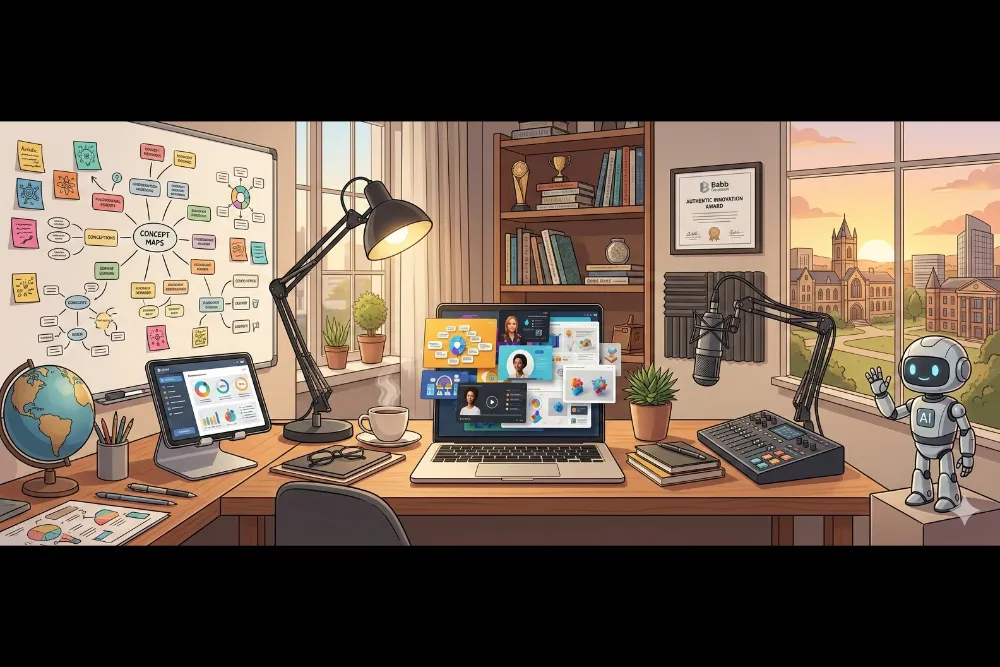
Maybe it is time to move away from linear writing and toward visual systems thinking. Have students use free digital tools, or simply draw on a piece of paper and snap a photo, to create a mind map connecting the week's theories. The real assessment comes from a required audio or written reflection where they explain why they connected certain concepts and how their understanding shifted. You are assessing the how of their learning, rather than just the what.
4. The Unessay
The unessay format gives students the freedom to choose how they wish to demonstrate their knowledge, evaluated against a single, flexible rubric. A student might choose to translate a complex scientific concept into a children's picture book, design a board game based on historical events, or create a detailed infographic. When students choose a medium that aligns with their personal interests and professional skills, they take far more ownership of the creation process.
5. The AI-to-Human Handoff
Instead of banning AI, build it directly into the assignment workflow. Allow students to use an AI tool to produce a first-pass outline, generate a piece of starter code, or draft a preliminary literature review. Then, require the student to complete the last mile. They must critically analyze the AI's output, correct its hallucinations, eliminate biases, and justify all of their revisions. This teaches them how to use AI as a critical tool rather than a crutch.
We all know that they will need this skill in the workplace.
6. Transparent Workflow Logs
When you do assign written work, grade the process alongside the final product. Require students to submit a log of their brainstorming and drafting phases. If they used AI as a sparring partner to bounce ideas around, they must share the prompts they used, the responses they received, and a short rationale describing what they kept, modified, or threw away, and why. This demystifies the writing process and forces a level of metacognition that AI cannot fake.
7. Social Media Roleplay
Ask students to construct theoretical social media profiles or dialogue threads for historical figures, literary characters, or prominent theorists in their area of expertise. By asking them to adopt a specific persona and debate a course topic within the constrained, specific format of a modern social media exchange, students have to demonstrate a deep, nuanced understanding of the subject matter that generic AI text generation almost always fails to capture convincingly.
High-stakes finals and generic term papers are becoming increasingly untenable in our current technological landscape. But this isn't a crisis; it is an incredible opportunity to redesign our courses for the better.
By prioritizing authentic assessments, we can verify student expertise while bringing trust, creativity, and joy back to our classrooms.
References
Anthology. (2024). AI, Academic Integrity, and Authentic Assessment: An Ethical Path Forward for Education. Anthology White Papers.
Press, N., et al. (2024). Beyond Detection: Redesigning Authentic Assessment in an AI-Mediated World. Education Sciences.